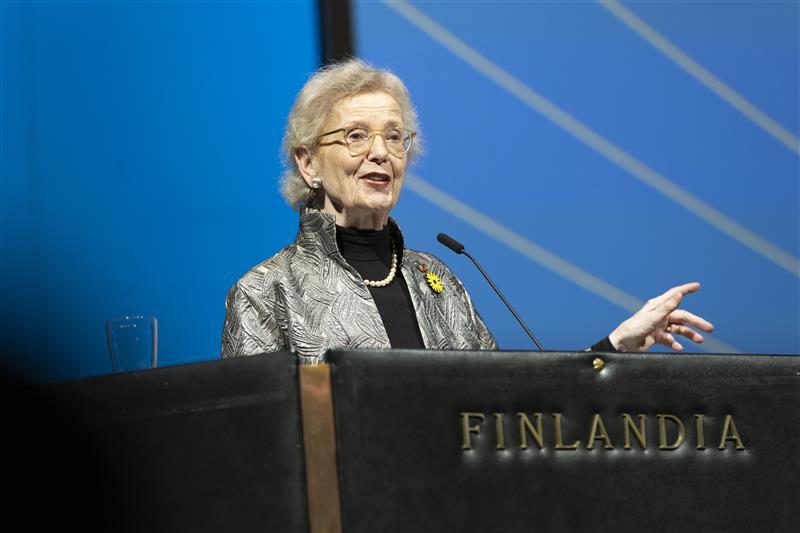
Good evening, and it’s an honour and privilege, and I have to say it’s a joy to be with you here this evening for this wonderful celebration of CMI’s 25th anniversary.
We’ve already heard great wisdom and indeed great passion, and I look forward very much to the conversation that I’ll have with my two sisters as we are moderated just after I have given my brief remarks.
But I want to start on a personal note: today is also a special day of memories for me, because on the 3rd of December 1990, I was inaugurated as the first woman President of Ireland. [applause]
That little dance that I did as I was coming up onto the stage is very much a tribute to Archbishop Desmond Tutu, the first Chair of The Elders. He taught me the importance of humour, and the importance at times of making yourself a bit ridiculous and making people laugh, so maybe then they’ll listen to you.
So there we are.
The themes of tonight’s discussions – the challenges of peacemaking, how the international landscape has evolved over the past 25 years and how to respond to these changed realities – could not be more timely.
But the principles underpinning CMI’s work are timeless: that lasting peace must be rooted in justice and human rights, and that the victims of conflict and atrocities must be at the heart of negotiations for a peaceful future.
These are the principles that inspired Martti Ahtisaari throughout his life and informed his approach to peacemaking across the globe.
I first got to know Martti when he was working for the United Nations on Namibia, helping that country on its way to independence and freeing it from the shackles of apartheid and occupation.
I admired how he combined an unwavering commitment to freedom and dignity with a deep understanding of the nuances and subtleties of diplomatic processes, and the need to pursue an inclusive approach rooted in open and good-faith dialogue to yield peace.
Over the years we built a firm friendship, and I always valued our discussions when I served as President of Ireland and later as UN High Commissioner for Human Rights.
Martti confided in me about his plan to run for the Presidency of Finland in 1994, a role he fulfilled with characteristic wisdom, humility and empathy as he helped navigate the country through the political and economic turbulence of the early post-Cold War era.
He also confided in me about his decision not to seek a second term as President, telling me he was following my example as President of Ireland! So I am honoured to have inspired him in a small way.
Martti’s achievements as a peacemaker in the early years of this century, from Aceh to Kosovo and of course his invaluable contribution to the Northern Irish peace process, will be familiar to everyone in this hall.
The fact that all three peace accords have held to this day is testament to his skills as a negotiator in crafting durable settlements – as is, of course, the role Namibia plays today as an equal, sovereign member of the global family of nations.
Given his achievements and knowing him as I did, I was delighted when Martti accepted the invitation to join The Elders in 2009, just two years after Nelson Mandela founded the organisation in 2007.
Martti was a natural fit for our group. He brought his characteristic humility to our meetings, always listening to others with great attentiveness – but when he did speak, he was the wisest person in the room.
As Elders, we travelled together to conflict regions and hotspots including Sudan, South Sudan and North Korea to promote dialogue, de-escalation and peacebuilding. We also both travelled to Myanmar, though on separate occasions, as part of The Elders’ efforts to promote a peaceful transition there.
Were he still with us today, I know Martti would be profoundly saddened that Sudan and Myanmar remain scarred by terrible conflicts and that North Korea continues to be a nuclear-armed international pariah.
But I also know that he would not allow this sorrow to lapse into fatalism, but rather insist that every conflict can be solved, provided there is the political will to do so.
This conviction drove him to establish CMI 25 years ago and has made it such a well-respected actor in the sphere of international peace, security and conflict resolution.
Ladies and Gentlemen,
To conclude my remarks, I would like to return to the words of Martti Ahtisaari himself, from an article he wrote exactly eight years ago when he announced he was becoming an “Elder Emeritus” and stepping back from the day-to-day work of our group.
He said then:
“I have dedicated my life to conflict mediation and have always held a firm belief in talking to all sides, in order to reach solutions that ultimately will halt the suffering of thousands, if not millions of people.
But these solutions require the powerful nations of the world, particularly those with the privilege of serving as Permanent Members of the UN Security Council, to act with courage and responsibility in conflicts where they can wield influence.
[…] All member states of the United Nations have to commit to the global values of the UN. These values have been fundamental to sustaining peace following the devastation of the Second World War. Their significance has not changed since. Yet many of today’s leaders have turned their backs on these commitments.”
What was true in 2018 is equally true in 2025, if not more so. As President Stubb so eloquently argues in his article published today in Foreign Affairs, “without a strong multilateral system, all diplomacy becomes transactional. A multilateral world makes the common good a self-interest. A multipolar world runs simply on self-interest.”
All of us here who share Martti Ahtisaari’s commitment to peace, dialogue and cooperation have a responsibility to ensure that our leaders fulfil their obligations, as he did so consistently.
We need fearless and determined organisations like CMI – and, in our own modest way, The Elders – to continue to work at both the grassroots and the highest global levels in the service of peace.
Martti Ahtisaari has bequeathed a powerful legacy to the world, of which CMI is living proof. I offer you my heartiest congratulations on this anniversary, and my ongoing commitment to keep working with you for a better, more peaceful and equal world for all.
Thank you.
Watch Mary Robinson's keynote address
Related Content
The Elders urge an end to the deadly conflicts in Sudan and the DRC
The Elders are appalled at the ongoing human suffering in Sudan and the DRC.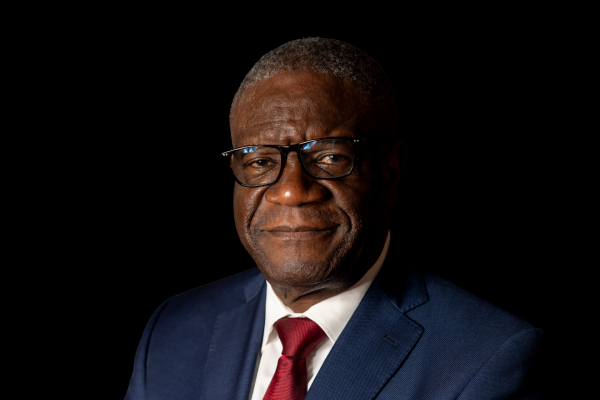
Without women, there can be no lasting peace
Denis Mukwege urges decisive global action to end conflict-related sexual violence and ensure women’s full participation in building lasting peace