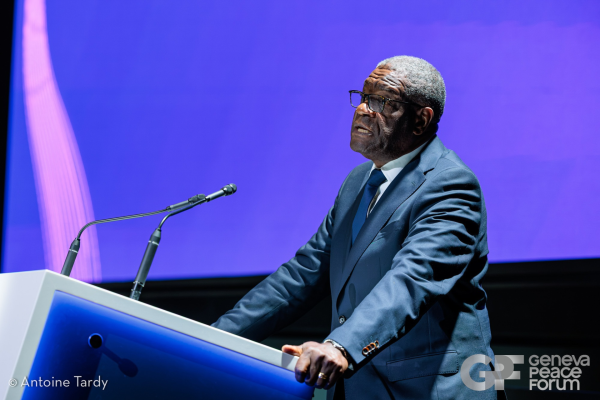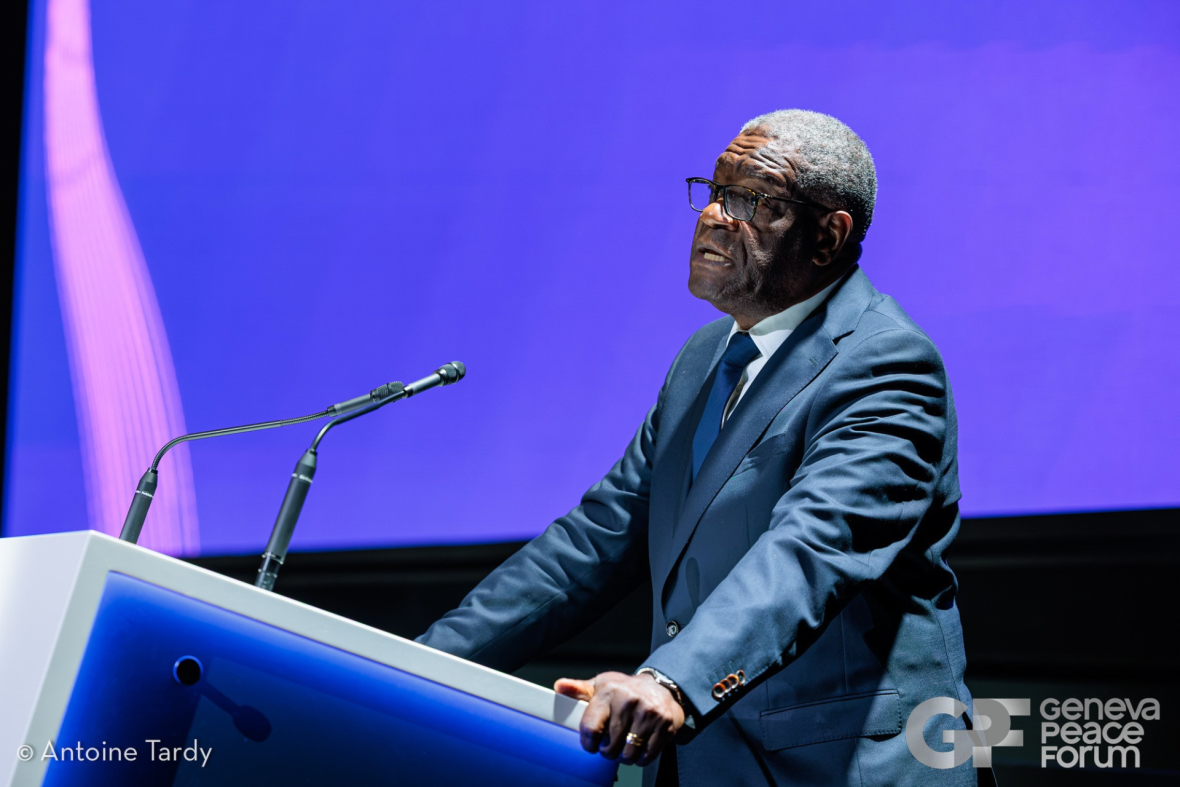
Denis Mukwege delivered the 2026 Kofi Annan Peace Address during Geneva Peace Week, reflecting on Kofi Annan’s legacy and the importance of choosing peace through respect for human rights and accountability for international crimes. He called for renewed diplomatic efforts to end the conflict in the DRC and secure lasting peace and stability in the Great Lakes region.
Read his remarks below.
Ladies and gentlemen,
Dear friends of peace,
It is a great honour to speak in Geneva, a city that has for so long embodied the hope of dialogue, justice and peace.
It is also a special honour to deliver this Kofi Annan Geneva Peace Address 2026, the highlight of Peace Week.
Kofi Annan dedicated his life to a deep conviction: that peace, human rights and development are inseparable. In ‘In Larger Freedom’, his report published in 2005, the former Secretary-General of the United Nations rightly stated that: ‘There is no development without security, there is no security without development, and there can be neither security nor development if human rights are not respected.’
The theme that brings us together today is therefore essential: ‘Choose Peace’.
At first glance, this choice seems obvious. Who would prefer war to peace? Yet, when we look at the world, we must acknowledge that peace is not always the option chosen.
Wars are being prolonged or flaring up again across several continents. Civilians are being targeted. Millions of people are fleeing their homes. Conflict-related sexual violence persists and is worsening, whilst humanitarian needs are increasing and funding for international aid is declining.
At the same time, the international order established after the Second World War has been profoundly undermined. The United Nations Charter is being flouted. International law is all too often applied with double standards. These double standards undermine trust in institutions. Human rights are in retreat across the globe, and when the law of the strongest takes precedence over the rule of law, everyone’s security is threatened.
So what does it mean to choose peace in a world where domination, fear, and violence seem to be gaining ground?
In my humble opinion, choosing peace means, first and foremost, reaffirming our shared humanity.
Opposing forces coexist within each of us: on the one hand, fear, hatred, the desire for domination and superiority; on the other, solidarity, altruism, cooperation and the recognition of others as our fellow human beings.
Our societies must constantly choose between these two forces.
Peace begins with our ability to recognise the humanity of others, to respect each other’s differences and to reject both discrimination and dehumanisation. This is why education on peace and human rights is essential.
Because wars do not begin merely when weapons are used. They take root when certain human beings are regarded as having less value than others; when hatred becomes acceptable and impunity the rule rather than the exception.
Choosing peace, therefore, also means choosing justice. Impunity is not merely an obstacle to peace: it paves the way for the conflicts and abuses of tomorrow.
Allow me to take this opportunity to share my joy at learning that Ms Navi Pillay’s tireless fight for human rights and justice has been recognised by the Nobel Committee, at a time when the International Criminal Court is facing unacceptable attacks.
Together, let us reaffirm today the importance of the principle that no one is above the law, and let us honour our promises to meet the imperative of justice for the victims of mass atrocities.
Dear friends of peace,
I wish to illustrate these issues by drawing on the situation in my country, the Democratic Republic of the Congo (DRC), which lies at the centre of geostrategic rivalries over control of its natural resources.
For more than three decades, the people of eastern DRC have lived through a cycle of war. The predatory exploitation of mineral resources has fuelled mass massacres, forced displacement and widespread and systematic sexual violence.
This conflict, the deadliest since the Second World War, cannot be reduced to an internal crisis. It is deeply internationalised and fuelled by economic and geopolitical interests that extend far beyond the Congolese borders.
In early 2025, the Rwandan army and its auxiliaries from the March 23 Movement (M23) and the Congo River Alliance (AFC) – now united under the name Front for the Rebuilding of the Nation (FRN) – seized control of Goma and then Bukavu, the capitals of North Kivu and South Kivu. Since then, more than ten million people have been living under the yoke of the occupying forces, caught in a vice-like grip between armed violence, hunger and the Ebola virus.
In response to this situation, on 21 February 2025, the United Nations Security Council adopted Resolution 2773. This resolution demands an immediate ceasefire, the unconditional withdrawal of Rwandan forces from Congolese territory, an end to support for M23, and the dismantling of illegitimate parallel administrations. It also reaffirms respect for the sovereignty and territorial integrity of the DRC.
But a fundamental question remains: what is the value of an international norm if those who violate it know they will not be held to account?
The credibility of the international order is not measured by the number of resolutions adopted, but by our collective ability to ensure they are upheld. Behind every resolution, there are human beings who are suffering and who long to live free from fear and violence.
If we want international law to remain a guarantee for all, it cannot be applied according to the power of states or the interests of the moment.
At the hospital and at the Panzi Foundation, we witness the human cost of this collective failure every day.
For more than a quarter of a century, we have been treating survivors of sexual violence, supporting their psychosocial and economic recovery, and helping them to access justice and regain a dignified place in society.
Our experience has taught us a fundamental truth: we cannot treat the consequences of violence indefinitely without tackling its root causes.
That is why our fight for women’s health has also become a fight for peace and justice.
Survivors must never be viewed solely as victims. They are agents of change and peacemakers.
Their courage reminds us that life can prevail, even after enduring the unspeakable. Their resilience, however, does not give us the right to ask them to endure ever more. On the contrary, it compels us to put an end to the violence inflicted upon them.
Dear friends of peace,
Choosing peace also means choosing diplomacy over the logic of force.
For three decades, a succession of diplomatic initiatives has sought to resolve the conflicts in eastern DRC: from Sun City to Nairobi, from Washington to Doha.
We must acknowledge the efforts made, but we must also face reality: despite these initiatives, no solution has succeeded in establishing lasting peace on the ground.
The rebel groups have changed their names, but those pulling the strings remain the same, and have never been held to account for their actions before the courts. Consequently, the people continue to suffer. Displacement continues. Human rights violations are extremely serious, whilst vast territories remain under the control of armed groups and foreign forces.
A gulf persists between the commitments made at the negotiating table and the reality experienced by the Congolese people.
We do not need yet another process that would simply be added to the previous ones. We need a political and diplomatic breakthrough capable of transforming existing commitments into concrete results and of moving from a crisis management approach to a strategy for ending the crisis, with a view to achieving a just and lasting peace.
That is why I am calling for the organisation of an international conference for peace in the DRC and stability in the Great Lakes region.
This conference should not replace the ongoing processes – notably those under the auspices of the African Union, the United States and Qatar – but rather coordinate and strengthen them, and provide the political impetus necessary for their effective implementation.
It should bring together the states of the region, the United Nations, the African Union, regional organisations, international partners and the mediators involved in the various processes.
It should also involve women in a meaningful way, in accordance with United Nations Security Council Resolution 1325, as well as young people, victims, community representatives and civil society organisations. For no peace can be sustainable if those who pay the price for it are excluded from its construction.
Finally, we advocate the involvement of the private sector, in order to promote a ‘Business for Peace’ approach. Investors and economic actors, including Congolese and international mining companies, must be involved in the negotiations, so that their interests contribute to stabilisation, the establishment of the rule of law and peace in the DRC.
This conference should serve to revitalise the Addis Ababa Framework Agreement and lead to a comprehensive, inclusive roadmap, accompanied by verifiable commitments, a precise timetable and binding monitoring mechanisms.
I call on the international community to rally support, exert real pressure on the forces of aggression and occupation, and ensure that international law is upheld. Diplomacy must guarantee that these commitments bring about real change in people’s lives.
True peace cannot be limited to silencing the guns. It must tackle the root causes of the conflict.
The first of these is impunity.
There can be no lasting peace without justice for the millions of victims of the crimes committed over the last three decades. Thirty years of war is thirty years too many. Thirty years of impunity is thirty years too many.
Justice is a prerequisite for preventing further atrocities and establishing peace.
We must support international investigations, strengthen cooperation with the International Criminal Court, activate universal jurisdiction and move towards the establishment of a Special Tribunal for the DRC. The international dimension of the conflicts and crimes committed demands an international judicial response.
But justice is not limited to criminal prosecutions. It must also enable victims to access the truth, reparations and guarantees of non-repetition. This requires, in particular, reform of the security sector and the overhaul of state institutions.
This is why we are calling for the adoption of a holistic national strategy for transitional justice in the DRC, the implementation of which is essential to breaking the vicious cycle of violence and impunity.
The second cause of instability is the war economy.
The DRC possesses natural resources that are vital to the global economy: coltan, cobalt, copper, gold, tin and tungsten fuel new technologies, the military and space industries, and the energy transition.
Yet this wealth does not guarantee prosperity for the Congolese people. All too often, it has become a source of exploitation, funding for armed groups and competition between regional and international actors.
A green or digital transition cannot be sustainable if it is fuelled by the blood of the people in the territories where these resources are extracted.
We must strengthen traceability and transparency in supply chains. Standards exist, but their implementation is lacking. Companies must know the origin of the minerals they purchase and face up to their responsibilities when they contribute, directly or indirectly, to the war economy.
States must also ensure the coherence of their trade, economic and diplomatic policies. We cannot claim to promote peace whilst tolerating opaque, mafia-like economic networks that fuel conflicts.
Finally, the DRC must be able to process more of its resources within its own borders, create added value and provide jobs for its people. Conflict minerals must become minerals of peace and development.
Dear friends of peace,
The DRC is not a distant war. It is a test of our collective conscience.
It shows us what happens when geopolitical interests take precedence over the principles of the United Nations Charter, when natural resources seem to be worth more than human lives, and when the law of the strongest prevails over the rule of law.
But it also shows us the resilience and capacity of human beings to rebuild their future. It shows us women rising to their feet, young people refusing to be a lost generation, and communities which, despite thirty years of war, continue to believe in the possibility of a better future.
Kofi Annan reminded us that peace requires courage: the courage to defend principles even when they seem difficult to apply, to speak out when silence becomes complicity, to choose dialogue when violence seems the easier option, and to defend human rights when they are under attack.
Human rights are universal. They cannot depend on the nationality of the victim, the power of the aggressor or geopolitical interests.
We cannot condemn a violation of international law here and accept it elsewhere.
We cannot proclaim the universality of human rights whilst practising selective outrage.
There can be no ‘double standards’.
Dear friends of peace,
Peace is never definitively secured. It is built every day, through our individual and collective choices, through our institutions, through our courage and through our solidarity.
“Choose Peace”. Let us choose peace rather than domination. Justice rather than impunity. Dialogue rather than violence. The rule of law rather than the law of the strongest. Solidarity rather than indifference. And our shared humanity rather than dehumanisation.
From Geneva, let us today choose to take a genuine leap forward.
Let us organise this international conference for peace in the Great Lakes region. Let us rally political will. Let us coordinate diplomatic initiatives. Let us give the commitments made the strength to become actions. Let us make justice a pillar of peace and the Congo’s wealth a lever for development rather than a driver of war.
And let us finally give the Congolese people what they have been calling for for so long: peace, justice, dignity and the opportunity to build their future.
For lasting peace here will always depend on peace elsewhere, and the international order depends on our ability to uphold the same principles and values everywhere.
We are interdependent. We are all in the same boat. We belong to a single human family.
Choosing peace, therefore, is not simply a matter of expressing a hope. It is about accepting a responsibility: rejecting indifference and acting together so that peace ceases to be a promise and finally becomes a reality.
Thank you.

Related Content

The current failure of leadership is not gender neutral
Mary Robinson delivered the Kofi Annan Peace Address at Geneva Peace Week 2024, calling for greater respect for humanitarian law and gender parity in leadership.
Each violation of international law emboldens others
Ernesto Zedillo explores how the international rule of law benefits us in our everyday lives, and why we cannot afford to take it for granted.
Palestine must not disappear
A statement by Mary Robinson, Graça Machel, Helen Clark and Hina Jilani following their visit to the Middle East, 11-16 July 2026