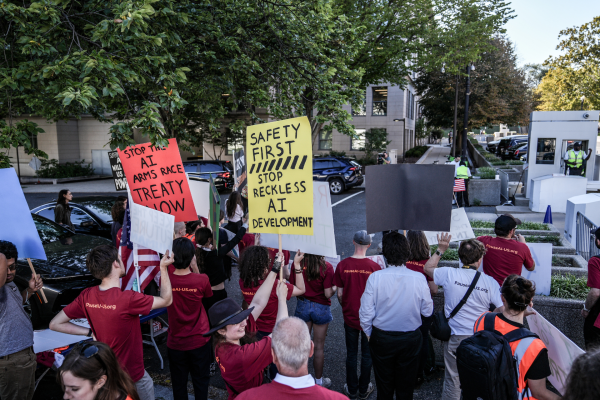
CALL TO ACTION: We call on governments worldwide to manage Artificial Intelligence with an urgency that reflects both scientific evidence and public concern.
A government’s first responsibility is to protect its citizens.
As the scale of AI capability accelerates exponentially, the current gap in governance is becoming a crisis. This must change. Governments have the power to change it - in their people’s interests.
We join together as a diverse group of AI leaders, Nobel prize winners, and former Presidents and Prime Ministers to recognise this pivotal moment for the world. AI innovation has the potential to bring great benefits, in healthcare, education, agriculture and elsewhere. But the harms are already visible, and expanding rapidly.
People expect their governments to regulate companies so profit is not prioritised over public safety. We reject claims that governments cannot or should not regulate AI: because technology moves too quickly, because companies will regulate themselves, because geopolitical competition matters more than public safety. These narratives are all misleading.
There is nothing inevitable about how AI develops. Who it benefits and harms is a shared global challenge, not a race between a handful of countries or companies.
We identify three areas demanding particularly urgent action:
Peace and security. Militaries are integrating commercial AI systems into weapons prematurely. These systems are already enabling violations of international law. The biological, chemical and nuclear risks could be catastrophic.
Rule of law and human rights. AI systems are enabling mass surveillance, discrimination and the erosion of civil liberties. AI is driving political disinformation, undermining truth, and exacerbating a breakdown in trust.
Environmental sustainability. AI data centres already consume more electricity than entire countries, and are depleting water reserves in drought-affected regions. These harms often fall disproportionately on the most vulnerable.
We call for a more inclusive global dialogue on AI governance, grounded in scientific research and committed to transparency and accountability. AI safety must be broadened to include its social, political, and economic impact. The United Nations has an essential role.
AI is here to stay. We urge governments and other stakeholders to work collectively to change its trajectory and build a more positive vision. AI should serve humanity, contributing to a safer, more peaceful and prosperous future for everyone.
ENDS
Juan Manuel Santos, former President of Colombia, Nobel Peace Laureate and Chair of The Elders
Gro Harlem Brundtland, former Prime Minister of Norway and former Director-General of the WHO
Helen Clark, former Prime Minister of New Zealand and former head of the UN Development Programme
Elbegdorj Tsakhia, former President and Prime Minister of Mongolia
Mary Robinson, former President of Ireland and former UN High Commissioner for Human Rights
Yoshua Bengio, most cited computer scientist, Turing Award winner, and Professor at Université de Montréal
Kate Crawford, Professor of AI, University of Southern California and Senior Principal Researcher, Microsoft Research, member of AI Council of Prime Minister Sánchez of Spain
Cynthia Dwork, Gordon McKay Professor of Computer Science at Harvard University
Alondra Nelson, Harold F. Linder Professor, Institute for Advanced Study; former Acting Director, White House Office of Science and Technology Policy
Maria Ressa, Nobel Peace Prize-Winning Journalist; Cofounder and CEO of Rappler; Professor of Professional Practice, School of International and Public Affairs, Columbia University
Stuart Russell, OBE, FRS, Distinguished Professor of Computer Science, University of California, Berkeley, and President, International Association for Safe and Ethical Artificial Intelligence
Marietje Schaake, Non-resident fellow at Stanford, Author of The Tech Coup
Lucy Suchman, Professor Emerita, Anthropologist of Science and Technology
Philip Thigo, Special Envoy on Technology, Republic of Kenya
Dame Wendy Hall FRS, FREng, Regius Professor of Computer Science, University of Southampton
Yi Zeng, Founding Dean, Beijing Institute of AI Safety and Governance, Professor, Chinese Academy of Sciences
For media inquiries, please contact William French, Head of Communications (+44 7795 693 903) or email: [email protected]
The Elders are grateful for the support of the Patrick J McGovern Foundation for their work on Artificial Intelligence.
Related Content
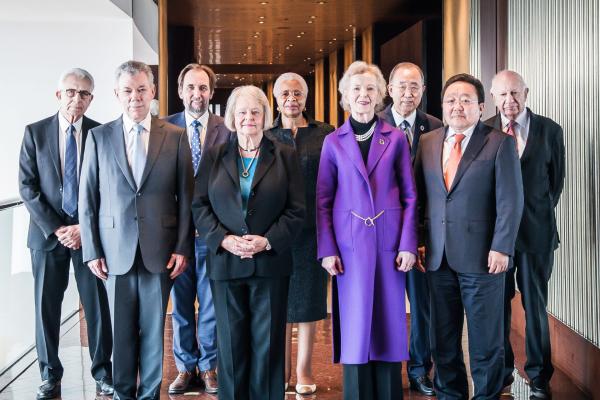
The Elders urge global co-operation to manage risks and share benefits of AI
The Elders today call on world leaders to work together urgently on the design of strong international governance, to allow all humanity to take advantage of the opportunities of Artificial Intelligence (AI), while limiting the enormous risks.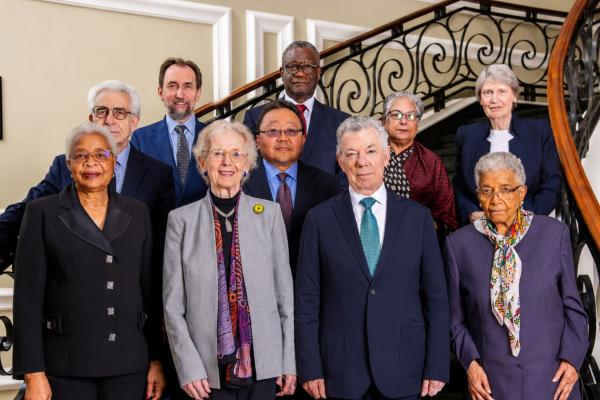
The Elders call for strong international leadership on AI governance after Summit of the Future
The Elders call for continued leadership from the UN and member states to drive forward inclusive global governance of AI