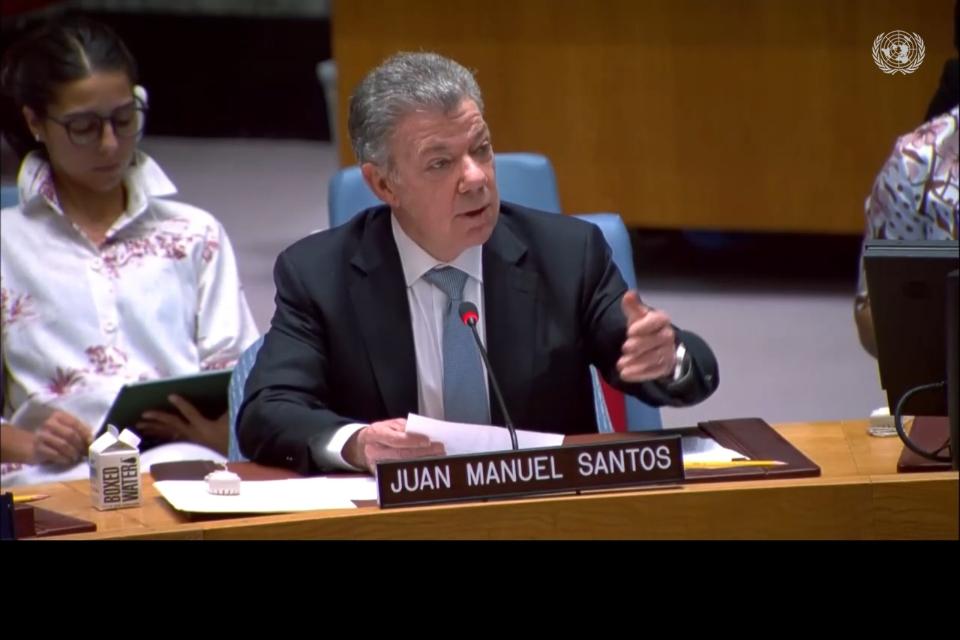
I would like to thank Ambassador Gregor Koessler for the invitation to speak today.
When Nelson Mandela convened the Elders – the independent group of global leaders that I have the honour to chair – he encouraged us to inspire hope. If I may, I would like to lay out a vision of hope for something that the world has been demanding for some time – reform of the UN Security Council.
Let us imagine the year is 2050. It is nearly 20 years since the Council was successfully reformed to create longer-term re-electable seats allocated by region.
These seats have significantly increased global representation on the Council, especially for underrepresented regions such as Asia, Africa, and Latin America – my own.
The Council is not perfect, but its workings have improved and the change has renewed some legitimacy in the multilateral system. The P5 members have been more hesitant to wield the veto, with the new tier of longer-term members providing some geopolitical counter-balance.
The Council has been able to adopt more robust positions in response to the waging of illegal wars, particularly when atrocity crimes are being committed in plain sight. It is better able to resist intimidation by powerful member states. The veto is under increasing scrutiny.
This reform was achieved through heroic diplomacy against the backdrop of grave threats to peace and security in the 2020s, notably: Russia's invasion of Ukraine; the conflicts in Gaza, Iran and the wider Middle East, Sudan, the DRC and elsewhere.
The key that unlocked reform was the compromise model tabled by the intergovernmental negotiations. This model didn't give anyone everything they wanted – but it proposed a better Council for everyone.
The five Permanent Members of the Council resisted the change. So did some of the states who felt they deserved the same privileges as those original five.
However, once two-thirds of the General Assembly approved the proposal, and national ratifications commenced, no-one wanted to be the last to approve. As in the 1960s expansion of the Council, the change came into force surprisingly quickly.
Ladies and gentlemen, I lay this vision out, not to imply that the task is easy, but to remind you that it is both possible and urgent – something my fellow Elder Ban Ki-moon emphasised when he spoke to the Council last December.
The world cannot wait much longer. The lawless age that many of us have feared is in many ways here, as constraints on the use of force by states are increasingly ignored.
The Elders believe three criteria are essential for any proposal for reform.
- It should improve representation and effectiveness of the Council.
- It should have a realistic chance of securing the support needed in the General Assembly.
- It should be a model that we can envisage coming into force after the necessary ratifications.
We support the proposal for longer-term, re-electable seats allocated by region, especially and urgently for those regions that are under-represented. In addition to improving representation and effectiveness, this would also increase accountability for member states serving longer term.
The Elders have long opposed any expansion of the veto, and I believe the wider membership will not support a proposal that risks making the Council even more ineffective by expanding veto privileges.
We believe all those seeking to serve longer term on the Council should be ready to do so without veto rights. And if the veto as it stands cannot be fully eliminated in the short term, models and practices that limit its use and increase its political costs must be supported. We also support proposals for a regular review mechanism to form part of any reform, so that the Council can adapt to an ever-evolving world.
In closing I would like to commend the ambition that the co-chairs of the intergovernmental negotiations process have brought to this process. We call on those states involved to come together, be open to compromise, and support the next step – for a consolidated model to be tabled in the General Assembly.
Remember that it will be impossible to keep everyone happy. Pursuing a perfect, consensus model will delay reform indefinitely.
But, and I say this based on my own experience, with collaboration and compromise, a great prize may be within reach – an improved Council that better serves the whole membership of the UN. Let us pursue that goal urgently – before it is too late.