AI must be developed and governed in the interests of humanity
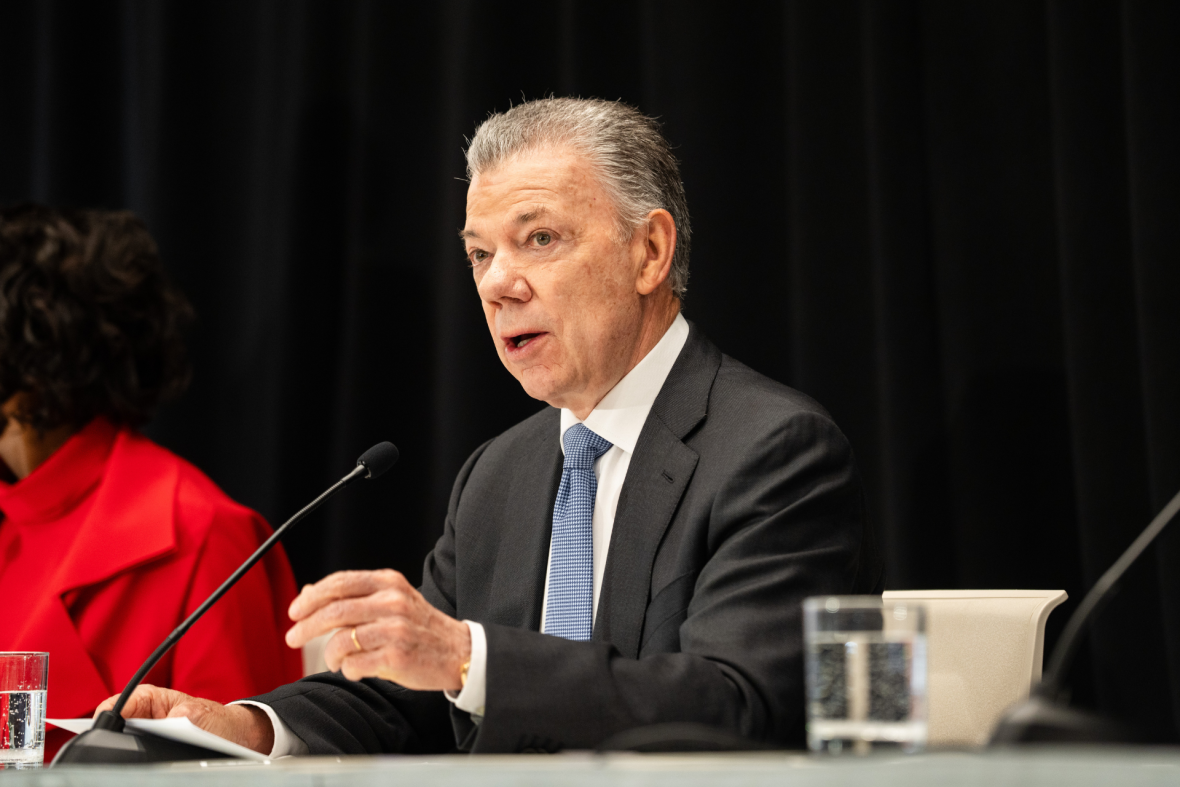
Speaking at a Vatican event on artificial intelligence and nuclear weapons organised by the Global Nobel Laureates Assembly, Juan Manuel Santos highlights the importance of ensuring that technology is developed and governed in the interests of humanity.
Watch his remarks:
Read his remarks:
Excellencies, colleagues, ladies and gentlemen,
It is a huge honour and privilege to address this Global Laureates Assembly on Artificial Intelligence and Nuclear War. I am deeply grateful to all the organisers for bringing us together in such a splendid setting for such solemn discussions.
The issues before us today are literally ones of life and death for the whole planet.
We face the profound challenges of ensuring that AI is developed and governed in the interests of humanity, and of effectively addressing the threats that AI poses to our future.
We also face a growing threat of nuclear war, amid the breakdown of US-Russia nuclear arms control, and the growth of a dangerous new arms race with rapid Chinese nuclear expansion. After decades of declining stockpiles, nuclear arsenals are beginning to rise again, and we are seeing leaders using increasingly overt nuclear threats, from President Putin to President Trump.
For those of us who grew up in the Cold War, when the threat of nuclear annihilation was ever present, and who then breathed a sigh of relief after the collapse of the Soviet Union, it is bewildering to once again be confronted by this nuclear threat.
Moreover, whilst in the 1970s and 80s hundreds of thousands of people took to the streets to protest in favour of nuclear disarmament, today the issue barely flickers on the radar of public consciousness.
This is why gatherings like this one, here today, are so important, to raise the alarm and seek to find solutions.
The urgency is even greater because alongside this, there has been an alarming breakdown in respect for international rule of law.
Just yesterday the US government announced they will go after anyone who supports the International Criminal Court. Can you imagine?
As highlighted in the Holy Father’s recent encyclical, we are seeing the erosion of ethical restraints in favour of the pursuit of raw power.
This risks leading us towards a “might is right” world in which the most powerful nuclear states feel entitled to use armed aggression against non-nuclear states.
The development of increasingly advanced Artificial Intelligence capabilities adds additional unpredictability into this mix.
Nuclear states may in general terms recognise that human control over nuclear use is important. However, there is insufficient understanding of the impacts of the increasing integration of AI into nuclear command and control, and the impact of AI is not accounted for in any existing nuclear agreements.
As our reliance on AI inputs for nuclear decision-making grows, so too does the risk of us losing meaningful human control over these civilisation-ending weapons.
These are issues that speak to the core of our common humanity. This is why The Elders, the group of independent global leaders founded by Nelson Mandela of which I have the honour to be Chair, have dedicated programmes of work on both AI and the nuclear threat.
We are deeply concerned that there is currently no binding global governance mechanism for AI. Without effective governance, it will be difficult, impossible, to ensure that AI becomes a force for good, guided by human dignity, responsibility, accountability, and the rule of law.
We applaud the Holy Father’s call to disarm AI, and his moral leadership. It is only by acting in a similar spirit that we can hope to tackle all the existential threats facing humanity, and bequeath a peaceful and sustainable world for future generations.
Related Content
NEW PODCAST - ProHuman: Governing the Global AI Revolution
An eight-part series where Elders and guests discuss the importance of international AI governance.