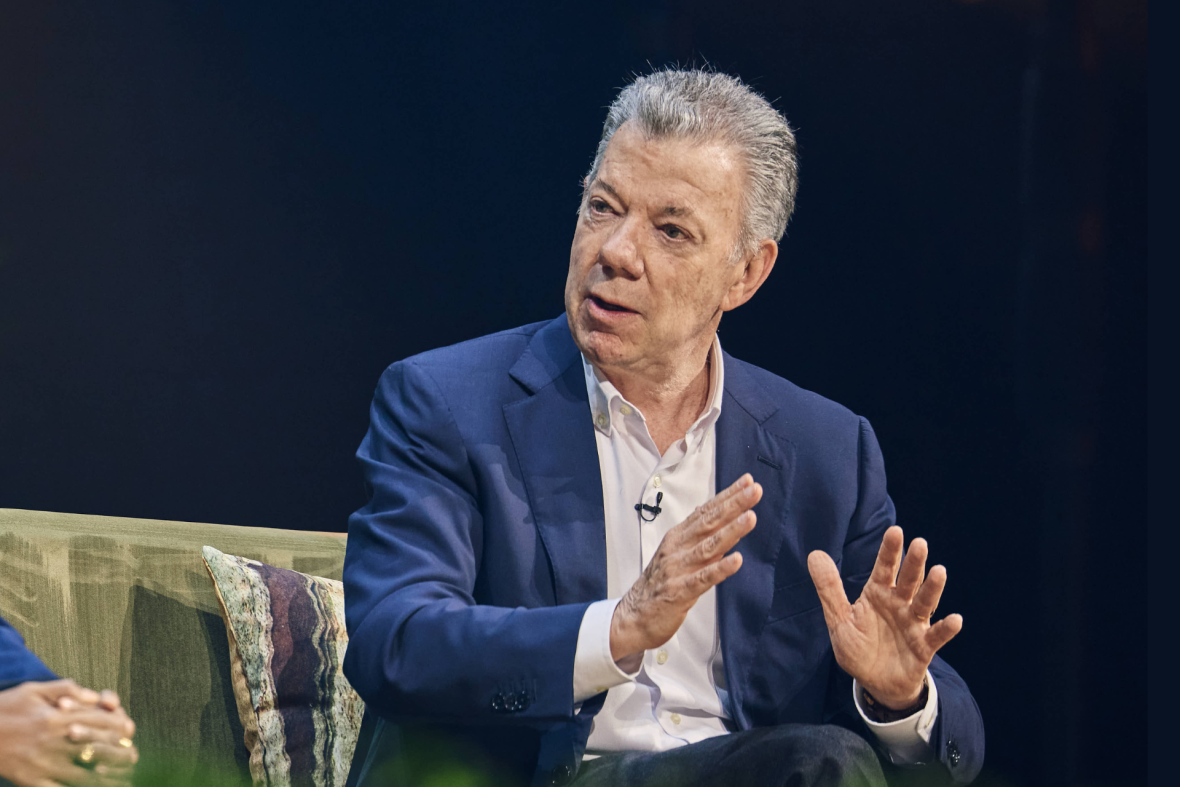
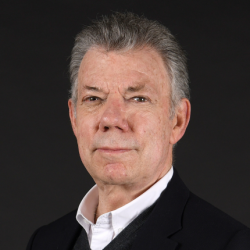
Chair of The Elders, Juan Manuel Santos, delivered the 24th Nelson Mandela Annual Lecture in South Africa on the theme “When is silence complicity?". Read his remarks:
Thirty years ago, I arrived in South Africa carrying within me the weight of a country at war.
I came in 1996 as former Trade Minister to hand over the chairmanship of the United Nations Conference on Trade and Development from Colombia to South Africa. What I expected to be a short formal diplomatic occasion instead gave me one of the greatest privileges of my life: spending nearly three hours with President Nelson Mandela, Madiba.
We spoke at that time about how our countries stood at very different moments in their histories.
South Africa was emerging from apartheid and confronting its painful past through the public hearings of the Truth and Reconciliation Commission.
I remember how deeply this impressed me when I watched those hearings that morning on television.
Mandela told me how victims and perpetrators were speaking before the nation, as a step towards reconciliation, and giving voice to truths that had long been denied or silenced.
Colombia, meanwhile, as I told Mandela, was descending into one of the darkest periods of its long conflict. Several presidential candidates and political leaders had been murdered only a few years earlier. The State had defeated the most powerful drug cartel the world had ever known. But we could not yet imagine the scale of the violence that lay ahead: the consolidation of powerful armed groups, the expansion of the drug trade, and the massacres that would devastate entire communities. The armed conflict with the guerrillas was underway at full speed.
I told him that, by then, violence had become so familiar that many Colombians no longer saw war as a tragedy, but as an inescapable part of our daily life.
Throughout our conversation, Madiba listened with extraordinary attention. This was one of his great qualities. He was an exceptional listener.
We spoke about the wounds left by violence, the difficult balance between peace and justice, and the courage required not only to confront an enemy, but also to imagine a peaceful future in which that enemy had a place.
At the end of our conversation, the room fell into a deep silence. Then Madiba looked at me and said: “Colombia and South Africa are similar countries in many ways, but without peace, Colombia will never take off.”
Those words never left me.
They reminded me of something I had learned many years previously while serving in the Navy: a sailor must always know the port towards which you are sailing. Without a clear destination, every wind becomes unfavorable. With a clear destination, even the strongest headwinds can help move the vessel forward. The same happens in your life, in business, in government.
That day in Johannesburg, Mandela helped me find my destination more clearly: a Colombia at peace. And I could never have imagined where that conversation would lead.
I could not have imagined that I would bear the responsibility of waging war as Minister of Defense and at the same time create the conditions to negotiate peace.
Nor could I have imagined that twenty years after meeting Mandela, Colombia would sign the 2016 Final Peace Agreement with the Revolutionary Armed Forces of Colombia, the FARC, the oldest and most powerful guerrilla movement in the Western Hemisphere, against which the Colombian State had fought for more than half a century. Our peace process was carefully planned and we drew lessons not only from South Africa, but from other peace processes around the world like Northern Ireland, Sri Lanka or El Salvador.
I could never have foreseen that, thirty years after meeting Madiba, I would return to South Africa as Chair of The Elders, the very organization he founded in 2007 to promote peace, justice, human rights and a sustainable planet.
And I certainly never anticipated that I would one day stand before you to deliver this lecture in Madiba’s name.
And I do so at a particularly meaningful moment, as Colombia marks the tenth anniversary of the Peace Agreement that ended decades of armed conflict with the FARC.
That gives this occasion an even deeper meaning.
The above may appear to be mere coincidence. But to me, it reveals something deeper.
An encounter became an idea. That idea became a purpose. That purpose guided decisions. And those decisions helped change the course of my country.
History is not predetermined. But encounters matter. Words matter. And silence also matters.
A few words, spoken at the right moment, can cross borders. They can last for decades. They can have an impact long after the person who pronounces them is gone.
Gabriel García Márquez, my fellow Colombian Nobel Laureate, once told me something I have never forgotten: a wrong word can start a war. But the right word can also build peace.
Silence can have that power too. It can allow injustice to endure, suffering to remain unseen, and promises to go unfulfilled. Silence, too, can start a war.
Not every silence is born out of fear. And many times silence itself demands a lot of courage.
Silence can create the space in which we truly listen. And listening constructively, learning from the other, was something Madiba always encouraged. Sometimes, words spoken too soon, or in anger, only make situations more difficult and they may close doors that should remain open.
The challenge, therefore, is not simply whether to speak or remain silent. It is to choose when silence becomes wisdom, or when it becomes complicity.
Could Mandela, with his profound moral intuition, have imagined that his words, and his silences, in that room in 1996 would travel so far (from Johannesburg to Bogotá) and endure for so long?
I do not know. But they did.
Twenty years after that memorable encounter, in 2016, Colombia chose peace. That peace has brought many benefits, some of which we are only now beginning to recognize.
But today, this is not a moment for silence. Communities across Colombia continue to wait for the full promise of what we signed, because the implementation of the peace agreement by the last two governments has left much to be desired. It is now more important than ever to speak out and demand the full implementation of the Peace Agreement.
South Africa and Colombia faced very different struggles.
South Africa negotiated the end of apartheid and the birth of a new, multi-racial democracy.
Colombia negotiated an end to a fifty-year war with the FARC not only to stop the killing but to address the causes of the conflict, and to bring the promises of the State to territories where they had long remained absent.
South Africa transformed the foundations of its political order. Colombia sought to make an existing democracy more equitable, and more accessible.
Yet beneath these differences, our two peace processes were shaped by similar dilemmas: moments when silence could allow peace to flow, or moments that could also prevent peace from ever arriving.
Imagine if silence had prevailed at the beginning of each process.
Mandela might have remained behind bars. The liberation movements might have remained banned. And apartheid might have endured because no leader was prepared to say aloud to white South Africans that it could not continue.
In Colombia, the State and the FARC could have remained locked in the same cycle of violence of the last 50 years, each convinced that the total defeat of their enemy was the only way of defining victory.
Instead, in the first decade of the twenty-first century, the three conditions we had identified as necessary for a successful peace process were slowly beginning to emerge.
First, military pressure had persuaded the FARC that it could no longer secure its objective through war.
Second, the countries of the region supported a negotiated solution, a necessary condition in any asymmetrical war.
And third, because they became vulnerable for the first time, the FARC leadership had begun to realize that it was in their best personal interest to have peace than to continue the war.
But favourable conditions alone do not produce peace.
Someone must seize the moment and lead the way by speaking out, even when silence offers the most secure and comfortable position.
I was elected President of Colombia in 2010 as a war hero. And when I spoke of making peace, almost everyone, even my own family, warned me against it.
“Don´t do it,” they said. “All efforts of peace with the FARC have failed. All your predecessors have failed. They will call you a traitor. You will lose all your political capital. And you will not succeed"
Continuing the war was a much safer choice.
But a good friend, Shlomo Ben-Ami, former Foreign Minister of Israel, gave me different advice. He said: “I know what you are going through. But imagine yourself at the end of your life, in front of your grave, looking back, and asking yourself: How many lives might I have saved if I had taken the risk and succeeded? Would you go to your grave with peace of mind knowing that you did not have the courage to take the risk of doing what you thought was correct?”
Those words convinced me to take the risk.
In both Colombia and South Africa, the earliest conversations required discretion and confidentiality. Peace sometimes needs silence to take root.
But there comes a moment when confidential talks must become public commitment, when leaders must tell their people that an enemy can become a partner, that history can change direction, and that peace is possible.
Had silence prevailed, South Africa and Colombia might have lost their moment, and another generation might have been condemned to war, violence and oppression.
Imagine now if violence had been given the final word.
In South Africa, the transition unfolded with massacres, political killings and moments when the country appeared close to civil war.
When Chris Hani was assassinated in 1993, the nation stood at the edge of catastrophe.
At that moment, if silence had prevailed, it would have left anger, fear and calls for revenge to fill the void.
But Madiba found the courage to address the nation. He called on South Africans to stand together, to meet grief with determination, and not to allow Hani’s assassination to destroy the democratic future for which so many had struggled. He urged them not to let sorrow and anger determine South Africa´s destiny.
Colombia faced a similar predicament.
I decided to negotiate while the conflict continued. In other words, no bilateral ceasefire was agreed at the outset, and negotiations proceeded without one until agreement had been reached on every item on the agenda. That was a deliberate, necessary but very difficult decision because every attack provoked outrage, and every death increased the pressure to walk away from the table. Negotiating peace and waging war at the same time is certainly difficult, but in this case it was necessary in order to have a serious peace process.
So violence was not allowed to have a veto over Colombia’s future.
Instead, in our desire for reconciliation we placed the victims at the center of the process. For the very first time in any peace process the victims were recognized and started to receive reparations before the war ended.
I will tell you an anecdote:
My former Harvard professor, Ronald Heifetz, warned me that I was choosing an extremely difficult path because making peace is harder than making war. He told me that I would experience the loneliness and silence of power, and that I would certainly become discouraged, and many times feel tempted to throw in the towel.
He therefore advised me to listen to the victims, to hear their pain and their dramas, because their stories would re-energize me, give me fuel to persevere and keep my destination clear.
He was right.
There was one particular story that impressed me the most: the story of Pastora Mira, from one of Colombia’s coffee-growing regions.
Her father was killed, her husband was killed, her brother was killed, and her son was tortured and killed. Three days after burying her son, a wounded young man knocked at her door asking for help. She cared for him and let him sleep in the bed that belonged to her recently buried son.
When he was cured and was about to go out, he saw a photograph of Pastora Mira and her son and he fell silent, knelt down and then shouted:
“Please, please don't tell me this is your son.”
Pastora said: “Yes, why do you ask?”
Then he started crying, repeating: “Please, forgive me, forgive me.”
She asked him what he meant.
“You have been so good to me. I have to tell you the truth. I was the one who tortured and killed your son”.
Pastora looked at him in silence, took him by the shoulders and said: “Stand up.”
She looked him in the eyes. He was still crying. Then she embraced him and said: “Thank you!”
Flabbergasted, he cried out: “why are you saying thank you if I have just confessed that I killed your son?”
She replied, with kindness in her eyes, that by telling the truth, asking for forgiveness, and taking responsibility, he had liberated her from hating for the rest of her life.
I invited Pastora to join me in Oslo when I received the Nobel Peace Prize. The same prize Mandela had received twenty-three years earlier.
And I said in my speech that I received the Nobel Prize in the name of Pastora Mira and the 10 million victims of this terrible war.
In both South Africa and Colombia, the peace processes survived because violence was denied the final word, and because the voices it had tried to silence were finally heard.
Lastly, imagine if we had left peace to fly alone after the agreements were signed.
South Africa could have declared its work complete after reaching a political settlement. But the agreement still had to become a constitutional norm based on equal rights, human dignity and the rule of law.
Former enemies still had to learn to live together under the same democratic institutions, in the same neighbourhoods, and even to play rugby together on the same team—as my good friend John Carlin so memorably recounted in his book Playing the Enemy.
The 1994 elections made that transformation real. Millions of South Africans voted for the first time, and Mandela became President. The Government of National Unity brought former adversaries together, while Mandela and F. W. de Klerk showed that former enemies could share responsibility for the future.
Colombia faced a similar test.
We reached a Peace Agreement with the FARC after more than fifty years of war and five years of negotiations. However, it was rejected by a very narrow margin in the 2016 referendum.
Why was it lost? I must acknowledge that we were over-confident and we underestimated the power of “fake news”. You cannot imagine the outrageous lies that were said. I thought that the people would never believe them. I was wrong.
Yet, we could have ignored the result and remained deaf to those who voted No. Or we could have used the defeat as an excuse to abandon peace altogether.
Instead, we chose to listen.
The day after the referendum, young people, like you, like the delegates of One Young World that we have the privilege to have here in the audience today, took to the streets. They filled almost every public square across Colombia and demanded a new agreement: “Agreement now!” That was their call.
Inspired by that energy and determination, we opened a national dialogue. We invited the opposition to sit down and jointly remake the agreement that was reached. We incorporated the great majority of their proposals and returned to the negotiating table with the FARC. A few days later, a new deal was struck.
The revised agreement was endorsed by Congress with a huge majority. The Constitutional Court later ratified the process. Since then, the Agreement has delivered significant achievements.
More than 13,000 former FARC members entered the reincorporation process. The United Nations received and decommissioned more weapons per guerrilla combatant than in any other peace process. A unique transitional justice system was put in place. And the FARC ceased to exist as an armed organization and became a political party.
In Colombia, bullets were replaced by ballots.
Across the country, communities used the dividends of peace to develop rural projects, launch reconciliation initiatives, and create productive opportunities. These efforts have strengthened social cohesion and kept the spirit of the Agreement alive.
The armed conflict was officially over, but fragmented dissident groups, sophisticated criminal organizations, and other armed actors have since expanded their territorial presence, sustained by drug trafficking, illegal mining, and other illicit economies. Their actions are not politically driven. They want territorial control and economic gain, through criminal governance. They have become very well connected and coordinated mafias, which is a problem that is affecting all Latin America and also growing here in Africa.
Some of my political rivals, for partisan reasons, and in a cynical distortion of the truth, try to argue that this is the result of the 2016 Peace Agreement. It is quite the contrary.
The lack of political will and skill of the last two governments to implement it fully, despite their constitutional obligation to do so, is the main reason for our current problems.
Precisely for that reason, the Agreement remains not only relevant but indispensable. It contains many of the answers to Colombia’s challenges: extending the rule of law into neglected territories, reducing rural inequality, protecting communities, strengthening democratic institutions, and replacing criminal governance with legitimate and effective state authority.
The lesson here is that implementing peace agreements is crucial. 50% of all peace agreements in the world have failed in the first five years because of lack of implementation.
In completing that work, Colombia has much to learn from the way South Africa has tried to preserve, renew, and defend the democratic settlement Madiba helped forge more than thirty years ago. But in both countries, there is much additional work to do to promote an equal and diverse society where the rights of all people are protected, regardless of race, gender, religion, nationality or political beliefs.
Real and durable peace is like a plant, it needs nourishment, care and permanent surveillance. And peacemakers need to persevere.
But this responsibility does not end at our borders.
My dear friends,
We must not remain silent in this world as war is once again normalized as an instrument of statecraft; as international law and the principles of the United Nations Charter are openly disregarded; institutions like the International Criminal Court are directly attacked and intimidated; and as civilians pay the price while atrocities go unchecked and diplomacy retreats.
The international order created to limit aggression and protect civilians is being eroded not only by those who violate its principles, but also by those who refuse to defend them, by those who choose to remain silent.
We must say it clearly: might is not right.
And few people have demonstrated that more clearly than Navi Pillay, whom I warmly congratulate on receiving the 2026 Nobel Peace Prize.
From defending anti-apartheid activists, including Mandela, to championing human rights and the rule of law on the world stage, her life reminds us that peace cannot rest on the will of the strongest, but on the strength of the law.
I hope this recognition encourages leaders everywhere to defend international law at a time when it is increasingly under threat.
When governments remain silent because speaking out is politically inconvenient or economically costly, they are not preserving neutrality or demonstrating geopolitical prudence. They are helping to turn violations into precedents, and precedents into a new international order governed not by law, but by force.
When states have the power to oppose injustice but choose inaction instead, silence stops being caution. It becomes complicity.
And complicity can become a habit. Leaders who grow comfortable looking away from one injustice to another, gradually lose the courage to act, the vision to lead, and the instinct to recognize threats that are existential.
A few months ago, at the Vatican, inspired by the pope's encyclical, I joined fellow Nobel laureates and other world leaders in signing a declaration on artificial intelligence and nuclear weapons. We warned that humanity stands at a threshold: eighty years into the nuclear age it is a miracle that we have not had a nuclear war. But the risk is growing. And now that we are entering the age of artificial intelligence, and since A.I. can end up making military decisions, we are on the edge of catastrophe. That is why the world cannot allow nuclear weapons technology and artificial intelligence to converge.
But the declaration went beyond machines and nuclear launch codes. It spoke to something on which peace has always depended: the value of truth, and the need to protect it in the age of artificial intelligence, because, as the declaration states, “without facts, there can be no shared truth. Without truth, there can be no trust. And without trust, there can be no dialogue, verification, or restraint between nations.”
None of this means rejecting the technology. Used well, artificial intelligence can help cure disease, protect the environment, extend education to those who have never had it. Used carelessly, it can wipe out jobs, deepen inequality, entrench authoritarian rule, and flood our societies with disinformation.
These are not fundamentally technical questions. They are questions of governance: who makes the decisions, whose interests are served, and who is held accountable when things go wrong.
Periods of geopolitical uncertainty are precisely when we must invest in dialogue, strengthen cooperation and speak out loud.
Thirty years ago, Madiba told me that without peace, Colombia would never take off.
Today, I can say that Colombia changed its course. But changing course is not the same as reaching the destination.
The journey remains unfinished in Colombia, in South Africa, and across a world where too many lives are still marked by war, exclusion, injustice, and fear.
Madiba left us a moral compass to reach that destination.
When he launched The Elders, Madiba called on us to support courage where there is fear, foster agreement where there is conflict, and inspire hope where there is despair.
He taught us that leadership is not about humiliating an adversary, but about building a future in which former enemies can live together.
And through both his words and his silences, he showed us that wisdom means knowing when to listen, and when conscience demands that we speak.
We can accept a world governed by force, or defend one governed by law.
We can allow technology to deepen fear and division, or ensure that it serves human dignity.
We can treat peace as the temporary absence of violence, or build the justice, opportunity and trust without which peace cannot endure.
And we can remain silent before unfinished promises and preventable suffering, or we can raise our voices, assume our responsibility and act.
During my years in the Navy, I learned that knowing the port of destination does not calm the storms. It does not remove the obstacles or guarantee a favourable wind.
But it tells us in which direction we must sail when the horizon disappears.
Mandela helped me see that direction clearly thirty years ago.
Peace remains Colombia´s destination. The full promise of freedom, equality and human dignity remains South Africa's destination. And humanity's destination must be a world in which law is stronger than force and truth is stronger than deception.
The waters ahead will not always be calm. But the destination has not changed. So, we must stay the course. We must complete the journey.
The destination is peace. We must defend our common humanity. And silence is not an option.
This message is especially important for the young people of the world—including those of you here today.
My generation has not always given you the world you deserve. But the future is not yet written. It is in your hands.
So stand for what is right, even when it is difficult. Take the initiative. Be bold. Protect our common planetary home. And never accept the idea that war, injustice or division are inevitable.
To paraphrase William Ernest Henley, whose words so deeply inspired Madiba: be the master of your fate and the captain of your soul.
Speak when silence becomes complicity.
Now it is your turn to take the helm.
Thank you very much.
Related Content
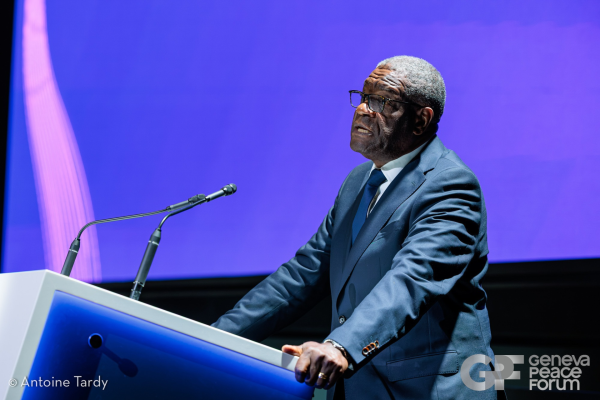
Peace begins with our ability to recognise the humanity of others
Denis Mukwege delivered the 2026 Kofi Annan Peace Address, calling for respect for human rights, accountability for international crimes and renewed diplomatic efforts to achieve lasting peace in the DRC and Great Lakes region.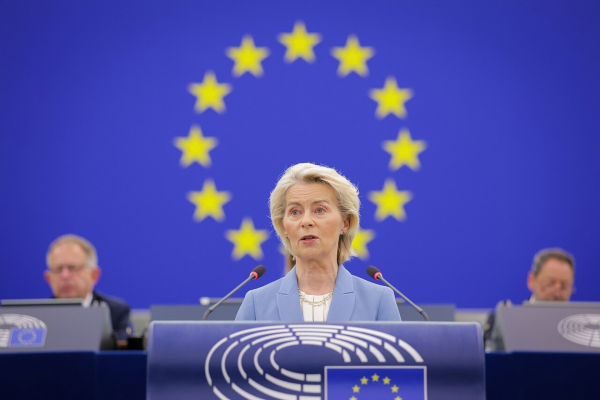
Dear President von der Leyen: Ban EU trade with illegal Israeli settlements
The Elders delivered an open letter to the President of the European Commission, Ursula von der Leyen, on Israel and Palestine.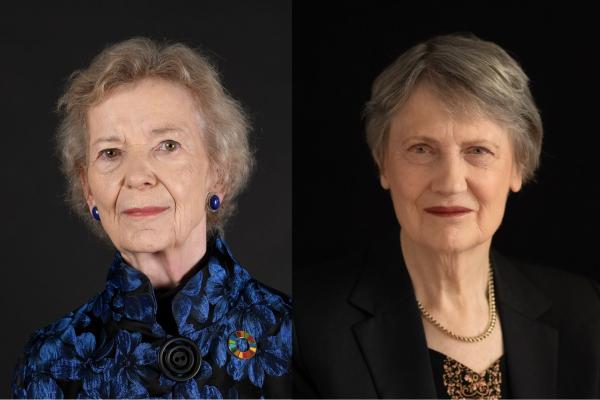
Mary Robinson and Helen Clark react to Israeli settlement trade ban by UK and others
Mary Robinson and Helen Clark react to the steps announced by the UK and other governments to ban trade with Israeli settlements.